You are about to sign a transaction on Arbitrum, but the wallet shows an unfamiliar contract, a token approval, and a gas balance you did not realize was empty. The dApp needs one network; your assets sit on another; and the transaction window offers little help beyond “Confirm.” This is the point at which a multi-chain wallet becomes more than a convenient address book. For users in Germany who move between Ethereum, Layer 2 networks, stablecoins, and bridges, the important question is not simply how to install a browser extension. It is whether the wallet helps you understand what a signature will do before an irreversible blockchain action takes place.
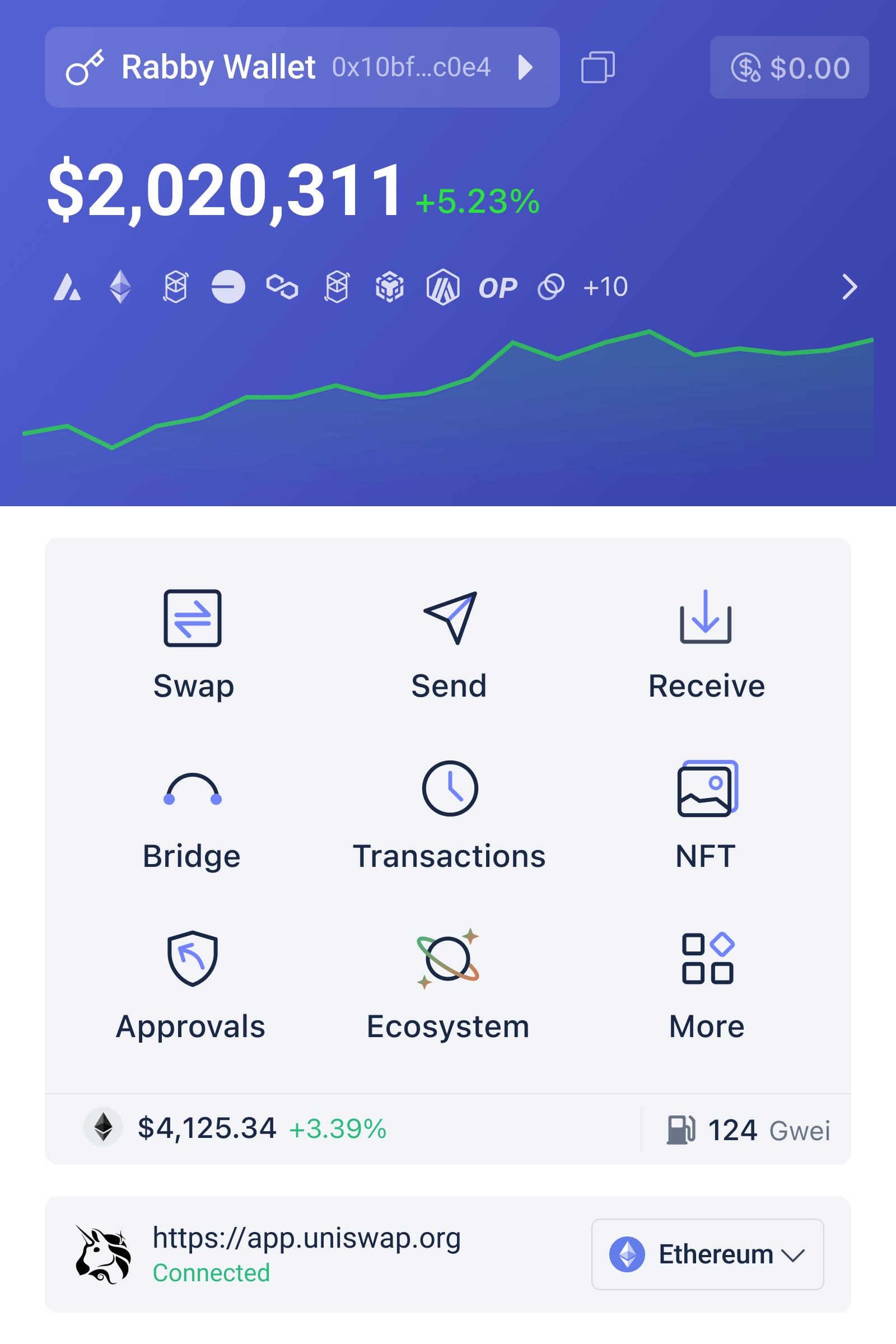
Rabby is designed around that problem. Developed by DeBank as a non-custodial wallet for DeFi, it supports more than 140 EVM-compatible networks, including Ethereum, Polygon, Arbitrum, Optimism, Avalanche, Base, and BNB Chain. Its recent Chrome Web Store description presents it as an open-source Ethereum and EVM wallet focused on a smoother multi-chain experience. That description is useful, but incomplete: the meaningful distinction lies in how Rabby inserts checking, simulation, routing, and network context into the signing process.
Why transaction simulation matters more than a polished interface
A conventional wallet often displays the technical payload of a transaction and asks the user to approve it. That model assumes the user can interpret contract calls, token allowances, recipient addresses, and network details. In practice, even experienced DeFi users may struggle to determine whether a signature transfers tokens, grants an unlimited approval, or interacts with a contract whose behavior is not obvious from the dApp interface.
Rabby’s transaction simulation addresses this gap by estimating the expected changes to token balances before signing. The key mental model is that the wallet acts as a preview layer: it does not merely ask, “Do you want to sign these bytes?” It attempts to show, “If this transaction succeeds, what should leave your wallet, what should arrive, and which permissions may change?” That makes the decision more legible.
Simulation is not the same as proof of safety. It depends on the state of the relevant blockchain, the behavior exposed by the contract, and the ability of the simulation system to represent that behavior correctly. A malicious or unusual contract may still create risks that a preview does not fully capture. Network conditions can also change between simulation and confirmation. The practical benefit is therefore risk reduction, not risk elimination.
The integrated security engine adds another layer by checking contracts and addresses for signals associated with phishing, known exploits, and potentially dangerous infinite approvals. This is especially relevant when users follow links from social media, search results, or newly launched protocols. A warning should be treated as a reason to stop and investigate, not as an inconvenience to click through. Conversely, the absence of a warning is not a guarantee that a contract is legitimate.
Installing Rabby and understanding the custody boundary
For most users, installing Rabby means adding the browser extension in Chrome, Brave, or Edge and creating or importing a wallet. Desktop applications for Windows and macOS, along with mobile applications for iOS and Android, extend the same general ecosystem. When obtaining the software, users should verify that they are using the official distribution channel and should never enter a recovery phrase into a website, chat window, or support form.
The custody model is fundamental. Rabby is non-custodial: private keys are stored locally on the user’s device rather than sent to Rabby’s servers. This means the provider does not hold the keys in the way a centralized exchange holds customer balances. It also means responsibility remains with the user. Losing a seed phrase, exposing it to malware, or approving a malicious transaction cannot generally be reversed by contacting a company.
This is where hardware-wallet compatibility becomes more than a premium feature. Rabby can work with devices such as Ledger, Trezor, and OneKey, allowing the private key to remain protected by dedicated hardware while Rabby provides the interface, simulation, and transaction context. The browser wallet can therefore function as a decision and display layer, while the hardware device remains the signing boundary. Users should still verify important transaction details on the hardware screen; connecting a hardware wallet does not make every dApp trustworthy.
Rabby also describes itself as independent from its backend in an important operational sense. It does not create or alter transactions on behalf of the user, and core signing functions can remain available if Rabby services experience an outage. That resilience is useful, but it should not be confused with complete independence from infrastructure. Wallet interfaces commonly rely on remote data for prices, risk signals, simulations, token metadata, and network access. A server outage may not compromise the keys, yet it can reduce visibility or convenience.
Multi-chain convenience: automation with a cost
Managing several EVM networks creates a recurring coordination problem. The same wallet address may exist across chains, but balances, gas assets, contract deployments, and transaction histories are network-specific. Rabby’s automatic network switching can detect the chain required by a connected dApp and move the interface to that network. For everyday use, this removes a common source of friction: manually changing networks and wondering why a balance or application is not appearing.
Automation, however, can hide context. A network switch is not merely a user-interface event; it changes which contracts, balances, gas markets, and transaction histories are relevant. Before signing, users should still confirm the chain, the dApp domain, the recipient, and the expected asset movement. The best workflow is not “trust automatic switching,” but “let the wallet reduce repetitive clicks while retaining deliberate review at the point of authorization.”
The same principle applies to swaps and bridges. Rabby includes a swap function that scans decentralized exchange routes such as Uniswap and 1inch to seek competitive pricing and lower slippage. An aggregator can improve execution by comparing available paths, but the quoted result depends on liquidity, timing, fees, price impact, and the route ultimately selected. The cheapest displayed output is not automatically the safest or most predictable route.
Bridge integration, including protocols such as LI.FI, allows users to move assets between supported blockchains from within the wallet interface. This is convenient because bridging normally requires coordinating source-chain approvals, bridge contracts, destination-chain settlement, and sometimes a second gas environment. Yet bridges add an additional security and operational layer. A familiar wallet interface does not remove bridge-contract risk, liquidity constraints, delayed settlement, or the possibility that an asset on the destination chain is represented by a different token contract than expected.
Gas Accounts and the economics of reduced friction
One practical feature for multi-chain users is the Gas Account, which allows network fees to be paid with stablecoins such as USDC rather than requiring the native token of every chain. This addresses a familiar failure mode: a user owns the asset they want to swap but cannot submit the transaction because the wallet lacks ETH, MATIC, AVAX, or another chain-native gas token.
Paying gas in a stablecoin simplifies the mental accounting of DeFi. Instead of maintaining small native-token balances across many networks, a user may be able to fund fees from a more familiar asset. But the feature does not abolish fees; it changes how the fee is sourced and routed. Users should inspect the conversion terms, supported networks, and any service dependencies. A “gas paid in USDC” experience can be easier without necessarily being cheaper in every circumstance.
Rabby Points, earned through activities such as swaps, gas top-ups, or referrals, introduce a loyalty layer. Such incentives may encourage users to explore features, but they should not determine financial decisions. A points programme has uncertain future value unless its rules and redemption mechanics are explicit. Paying unnecessary fees or taking additional protocol risk to accumulate points reverses the proper order of priorities.
A decision framework for cautious DeFi users
For a first transaction after installing Rabby, a simple four-part review is more valuable than relying on a brand reputation. First, identify the network: is the dApp connected to the chain you intended to use? Second, inspect the simulation: which assets are expected to leave, arrive, or become approved? Third, examine permissions: is the approval limited to a sensible amount, or does it grant broad and indefinite access? Fourth, verify the destination and the source of the dApp link independently.
This framework reveals a less obvious point. Wallet security is not a single product attribute; it is a division of labour between code, infrastructure, and user judgment. Open-source software, released under the MIT licence, can be inspected by the community, but open source does not mean every deployment is bug-free or every user reads the code. Local key storage protects against some custodial failures, but not phishing or compromised devices. Simulation improves visibility, but cannot guarantee the future behavior of a contract. Security is therefore layered, and each layer covers a different failure mode.
For German users, this distinction also matters in operational and regulatory contexts. A wallet is generally a tool for interacting with networks, not a substitute for keeping records of transactions, understanding taxable events, or checking the legal and tax treatment of swaps, bridges, and rewards. The interface may make an action feel like a simple exchange, while the underlying activity can involve disposals, fees, liquidity routes, or multiple on-chain steps. Practical convenience should not be mistaken for simplified accounting.
What to watch as multi-chain wallets evolve
The direction suggested by Rabby’s feature set is a shift from passive signing toward transaction interpretation. If simulations become more accurate, security warnings more contextual, and cross-chain routes more transparent, wallets could become the main risk-control surface for retail DeFi. The important signal would not be the number of supported chains alone, but whether users can reliably understand permissions, bridge exposure, and expected outcomes across those chains.
The unresolved question is how much automation users should accept. Automatic network selection, route aggregation, stablecoin-funded gas, and integrated bridging reduce friction, but friction sometimes serves as a useful pause. A sensible future design would make routine actions fast while making unusual or high-risk actions slower, clearer, and harder to approve accidentally. Until then, users should treat every convenience feature as a trade: fewer manual steps in exchange for a greater need to inspect what the wallet is abstracting away.
Readers who want to review the installation path and supported wallet context can use rabby as a starting point, while independently checking the official distribution channel before downloading. The durable lesson is not that one wallet removes DeFi risk. It is that a good multi-chain wallet can move some of the most important questions—what changes, where it changes, and which permissions are granted—closer to the moment when the user can still say no.
FAQ
Is Rabby a custodial wallet?
No. Rabby is designed as a non-custodial wallet, with private keys stored locally on the user’s device rather than transmitted to Rabby’s servers. The user remains responsible for seed-phrase security, device security, and transaction approval.
Does transaction simulation guarantee that a DeFi transaction is safe?
No. Simulation shows the expected effects of a transaction and can reveal suspicious asset movements or approvals, but it is not a guarantee. Contract logic, blockchain state, timing, malicious interfaces, and infrastructure limitations can all create risks that a preview does not fully capture.
Can Rabby pay gas fees with stablecoins?
Its Gas Account feature is designed to let users pay supported network fees with stablecoins such as USDC, including when they do not hold the native token required by a particular chain. Users should still review availability, conversion terms, and the networks supported for the specific operation.
Is a hardware wallet still useful with Rabby?
Yes. Hardware-wallet integration can keep private keys in a dedicated signing device while Rabby supplies the browser interface, transaction simulation, and security context. It improves key protection, but users must still verify transactions and avoid approving unknown contracts.